

Site Search
Search within product
第722号 2020(R02).07発行
Click here for PDF version
§ Fertilizers and nutrients:
被覆燐硝安加里(ロング・ハイコントロール・Nutricote)の特性について(その3)
Shibata Professional Engineers Office
柴田 勝
§ Utilization of Soil Data in Aichi Prefecture
Aichi Prefectural Agricultural Experiment Station
瀧 勝俊
Fertilizers and nutrients:
被覆燐硝安加里(ロング・ハイコントロール・Nutricote)の
特性について(その3)
Shibata Professional Engineers Office
柴田 勝
10)ロングを使用した施肥法について
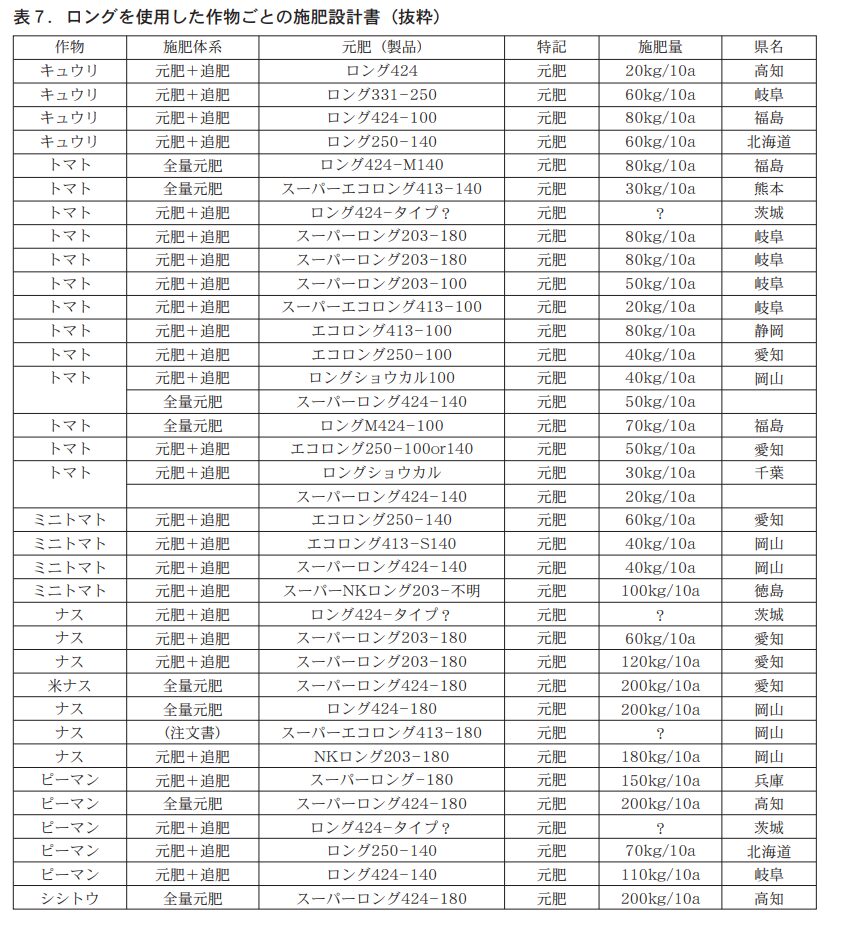
Long's new fertilizer design manuals have been devised and disseminated nationwide through fertilizer efficacy tests and extension trials tailored to the growing conditions in each prefecture for many crops. In fruit and vegetable crops, where nutritional and reproductive growth occur simultaneously, fertilizer application is an important technology for achieving high quality and high yield, because it is necessary to determine the timing and amount of nutrient fertilizer application by watching the fruit development process.
Based on the excellent nutrient supply performance of Long, a system of fertilizer application with emphasis on the primary fertilizer has been developed to simplify the fertilizer application technique. The examples of fertilization designs shown in Table 7 are based on the application of Long as the base fertilizer, with an appropriate amount of additional fertilizer applied according to the growth conditions of the crop. While the total basal application system is widely used for paddy rice, most of the fruit and vegetable crops, which require a longer growing period, have a basal application plus additional fertilizer system, in which fertilizer is applied while watching the crop's face.
The longs used in the fertilizer design are diverse, with the brand and type selected in accordance with the local fertilizer application system. There is also a shift to a total source fertilization method using longs and a progressive fertilization method in which longs are used for additional fertilizer.
Although a lot of test data has already been accumulated for long and high control, the "Long and High Control Test Data Collection," which consolidates the test results published since 2009 in the categories of "Fruits and Vegetables," "Leaf and Stem Vegetables," "Root Crops," "Fruit Trees," "Flowers and Trees," "Craft Crops," and "Forestry and Containerized Seedlings," has been compiled by JCAM Agri Co. The data is compiled by JCAM Agri Co. According to the data, root zone fertilization methods for various crops in the horticultural field have recently been studied, and long-high control has been taken up.
11)ロングを使用した根域施肥法の事例紹介
(1) Long cultivation of healthy paddy rice seedlings
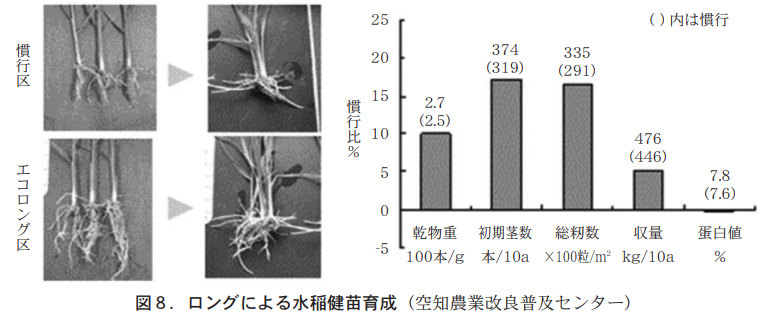
The "field nursery" method, which is superior in rooting ability, has been used in paddy rice seedling cultivation methods. In cold regions, it is known that seedling vigor after transplanting affects seedling yield, and a new method was developed to grow seedlings with 50 to 100 g of Long 424-100 fertilizer applied to the seedling boxes in order to grow seedlings with rooting vigor equivalent to that of "field seedlings" in the easy-to-manage "water seedlings" method. Seedlings grown with this method have high rooting power, grow well after planting, and produce higher yields than conventional seedlings, and the method has been widely used from Tohoku to Hokkaido (Figure 8).
(2) Local fertilization of fruit and vegetable crops
Even in horticultural crops, where full-layer fertilization has been the mainstay, local application methods have been demonstrated with the advent of coated fertilizers.
(1) Tomato: Total in-pot fertilization method (Soil Fertilizer Department, Shizuoka Prefectural Agricultural Experiment Station)
When tomato seedlings are potted into No. 4 pots, Superlong 424-140 is added along with medium to grow tomato seedlings, and when the seedlings have grown, they are removed from the pots and transplanted into the main field. (The amount of nitrogen fertilizer applied was reduced from 20 kg to 16 kg/10 a.) The yield was higher than that of the conventional method. This is a practical fertilization method that outperforms conventional methods in terms of yield (Fig. 9, Tables 8 and 9).
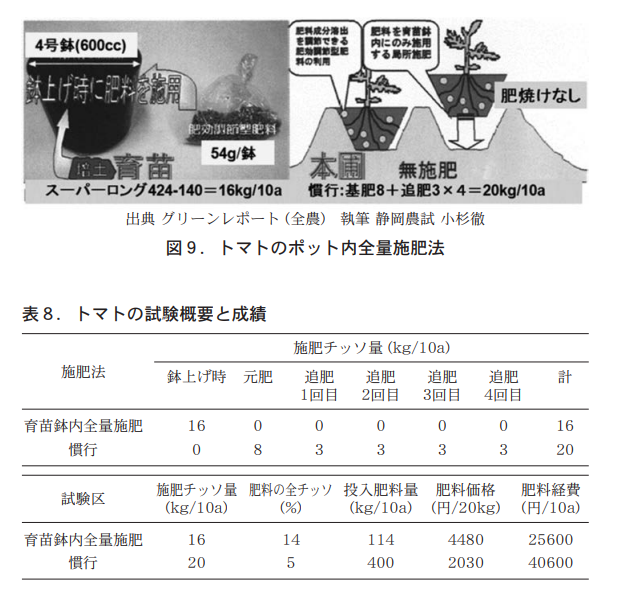
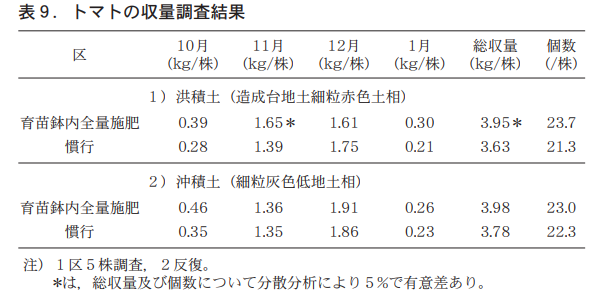
The total in-pot fertilization method frees the farmer from fertilizer application work, allowing him to concentrate on other tasks such as harvesting and picking, and thus enables the farmer to expand the scale of his business. Since fertilizer application is not required in the main field, it is no problem to make ridges long before planting, allowing for the dispersal of field preparation work. In order to popularize this method of fertilization, it is necessary to support the development of inexpensive metering equipment that applies a fixed amount of long fertilizer in pots.
(参考)植穴施肥とは(写真4)
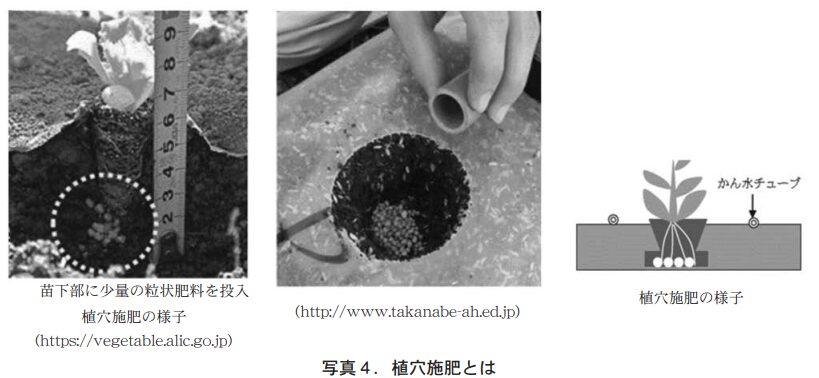
This is literally a fertilizer application method in which holes are drilled with a drilling machine in the area where the seedlings are to be planted, and the required amount of fertilizer is dropped into the holes and mixed with the soil before the seedlings are planted. Since the new roots that develop after planting come into direct contact with the fertilizer, long fertilizers containing nitrate-form chisso are used. In addition, this study was also conducted to develop an accessory equipment for transplanters that transplant lettuce seedlings and apply a fixed amount of fertilizer in the planting hole. Reduction of planting labor is a particularly important issue for agricultural corporations with large planted areas of leafy greens, and the development of machinery that simultaneously performs planting and fertilizer application at the time of transplanting seedlings is expected to advance. For vegetables with high planting densities that are generally covered with mulch, the Long will be used in a wider range of applications, including reducing the labor required for fertilizer application.
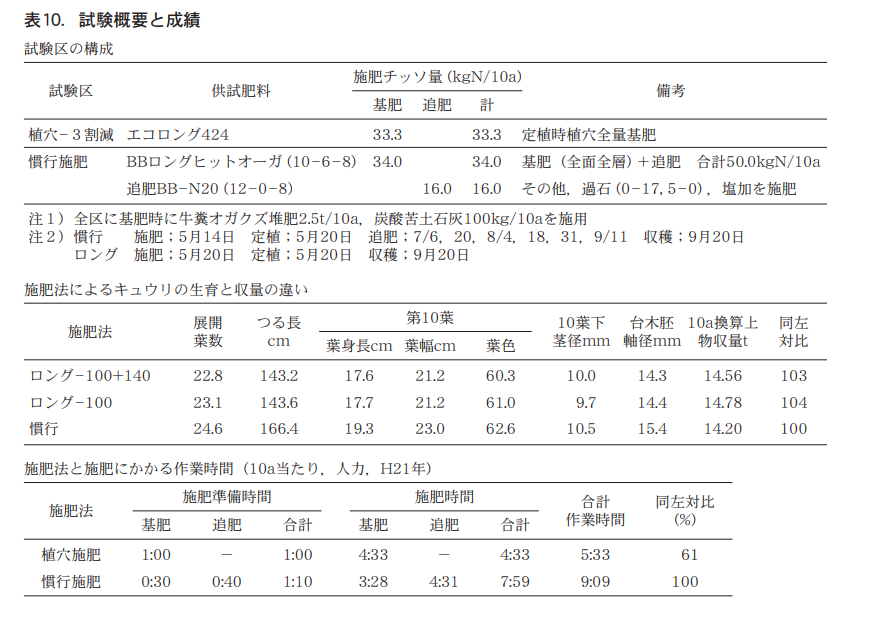
Cucumbers: Total basal fertilizer in planting hole at planting time (Nagano Prefectural Nanshin Agricultural Experiment Station)
エコロングを植穴施肥した,キュウリの露地普通栽培において減肥と追肥の省力化が可能な施肥技術が開発された。5月下旬定植で収穫時期が9月下旬の場合,エコロング100タイプ単用または140タイプに100タイプを30%配合して用いる。本施肥法では慣行の施肥法と比べ3割減肥しても同等の上物収量が得られる。また,追肥が省略できることによる施肥の省力効果が高く,肥料経費も削減できる(表10) 。
(3) Cellulose: Total basal fertilizer in planting hole at planting time (Shizuoka Prefectural Agricultural and Forestry Experiment Station)
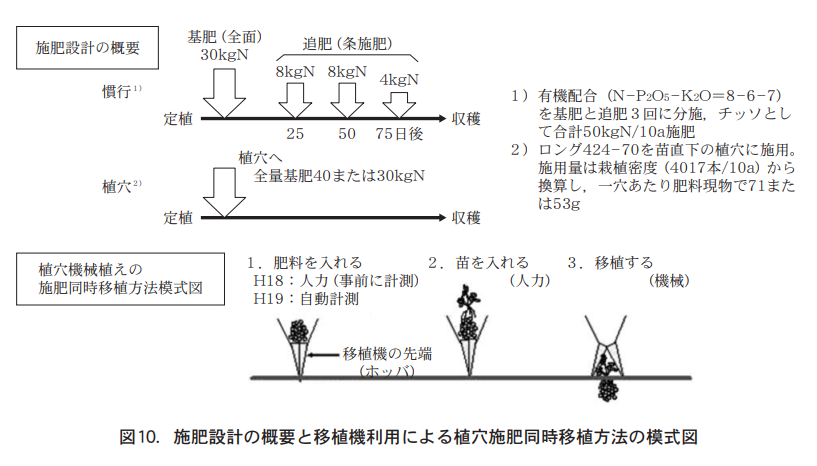
セルリーは栽培期間が長期にわたり,また施肥チッソ量が多い野菜である。収量を低下させることなく,施肥チッソの利用率を高めて減肥を達成するためには,肥効調節型肥料を用いた施肥が有効である。セルリー栽培において被覆肥料(ロング424−70)を用いた植穴施肥に加えて移植機を利用した植穴施肥同時移植について検討された(図10) 。
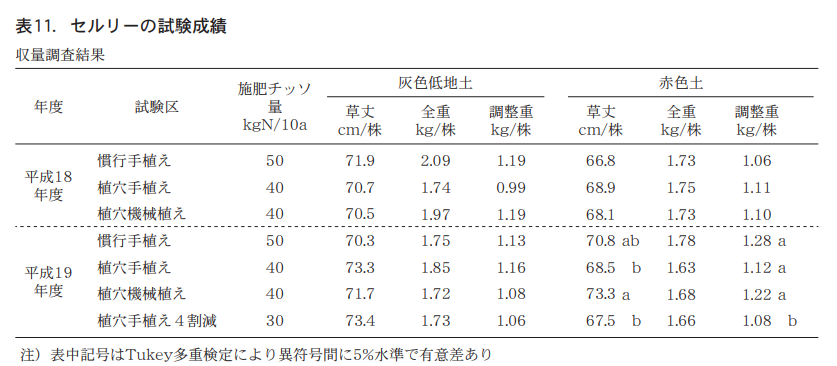
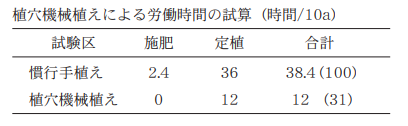
The cultivation method in which the amount of nitrogen fertilizer applied to the planting hole is reduced from 50 kg to 40 kg/10 a and long fertilizer is applied, and celluloid seedlings are planted, also produces yields equivalent to the conventional fertilizer application method. Simultaneous transplanting using a transplanter with hole fertilizer application enables a reduction in labor time to about 1/3 of that required for conventional cultivation, thus saving labor as well as reducing fertilizer (Table 11). The use of mechanical transplanters for planting large numbers of leafy vegetable seedlings has advanced, and it is estimated that their use is expanding. If these transplanters can be equipped with an automatic fertilizer dosing machine, the number of planting hole fertilization methods for leafy vegetables will further increase.
(3) Barrel-shaped large pot cultivation
This is a cultivation method in which coconut fiber is added in mortar-shaped barrels made of reinforced styrofoam as a substitute for soil and a special fertilizer (based on Hi-Control) for total basal fertilizer that does not require additional fertilizer. There are cases where 850 pots are grown in one greenhouse.
(4) Future development of root zone control cultivation
There are many examples of controlled root zone cultivation. Although the amount of fertilizer demand used on a single farm may not be large, the number of farmers adopting new cultivation methods is expected to increase due to the remarkable progress in cultivation facilities and equipment. Strawberry cultivation, which used to be done in the ground, is now going to be dominated by upland cultivation due to the aging of farmers, ease of field management, and safety and security requirements.
Root zone control cultivation of many crops is expected to increase as field management becomes more mechanized. The use of long and high control, including nitrate-form chisso, suitable for this cultivation method is expected to expand.
12)根域制御栽培へのロングの需要拡大に向けて
The most labor-intensive tasks in agriculture are planting and harvesting. In rice paddy farming, a riding fertilizer application machine that can plant seedlings and apply fertilizer at the same time has been put to practical use, and in harvesting, the development of unmanned harvesters is now being pursued in place of riding harvesters. In the future, reducing labor at the time of planting leafy greens, which are planted in large numbers, will be an important issue. The development of a granular localized fertilizer application machine for vegetables has already been attempted, and it is expected that more user-friendly machines will be developed (Table 12, Photos 6 and 7).
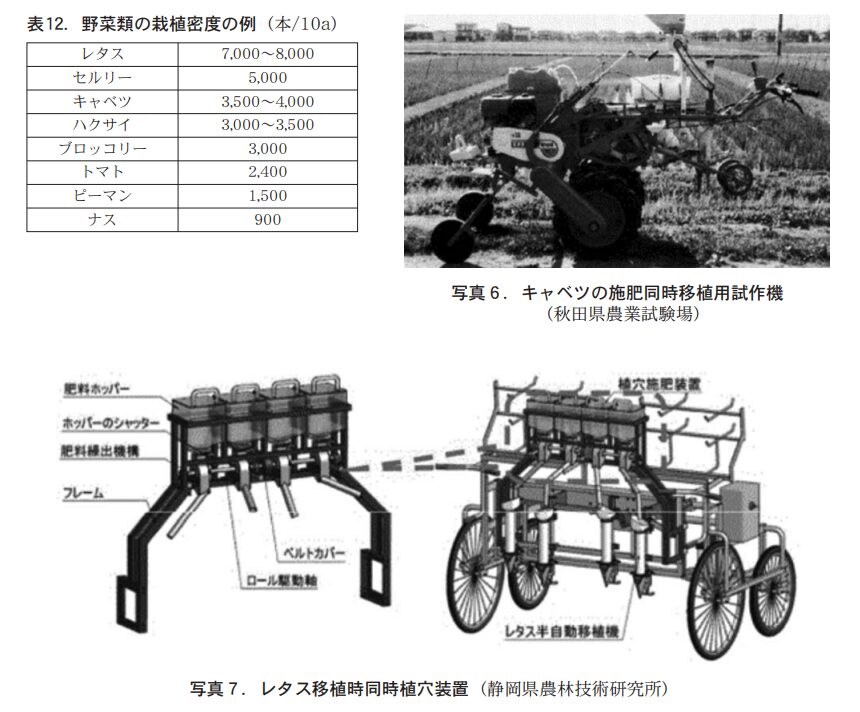
When agricultural machinery manufacturers develop this equipment, it is necessary to explain the advantages of using long, which contains nitrate-form chisso and is best suited for local application of fertilizer in planting holes and pots, and have them incorporate it into their designs. In the commercialization of "Okudake," a teapack filled with Long, we explained the characteristics of Long and completed the manufacturing process by changing the sliding plate to a brush to prevent damage to the film. We believe that tie-ups with agricultural machinery manufacturers from the initial stages of fertilizer equipment development are important for increasing demand for the Long in the planted hole fertilizer application method.
Utilization of Soil Data in Aichi Prefecture
Aichi Prefectural Agricultural Experiment Station
瀧 勝俊
Introduction
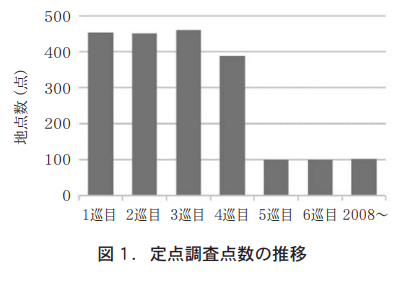
本県には,土壌データとして,調査,研究,行政対応を通じて多くのデータが蓄積されている。紙ベースのもの,デジタル化されたもの様々である。日常的に活用されているものとしては,国の事業として1940年代から継続実施されている土壌保全調査事業の成果としてまとめられた地力保全基本調査総合成績書1),土壌図2),土壌環境基礎調査成績書3)などの定点調査のデータがある。本県においては,1979年からの土壌環境基礎調査において約450点の定点を調査していたが,1998年から事業が組み替えられ,調査点数が1/4となった(図1) 。
定点調査では,5年おきに同一ほ場の土壌断面調査,土壌分析,土壌管理の実態調査を実施してきた。一方,長期の土壌,施肥管理が土壌,作物生育に及ぼす影響を調べることを目的とした基準点調査について,水田では,今年で95年目となる五要素長期連用試験(安城市)及び土壌改良を目的とした連用試験(日進市)を,畑では,試験場内(長久手市)で,有機物連用試験を実施してきた。
五要素長期連用水田以外の連用試験は,場所の変更を余儀なくされての中断や継続の意義を問われて中止の憂き目に遭ったこともあり,継続年月は長期連用水田には遠く及ばない。野菜畑における有機物連用試験は,その他にも設置され,かつて国の指定試験地であった東三河農業研究所(豊橋市)においても鉱質土壌における土壌改良を目的とした長期有機物(汚泥を含む)連用試験が実施されていた。
それらの調査結果,試験成果については,研究報告等や学会等において数多く報告されており,その成果は,本県の施肥基準4),有機質資材施用基準5)への反映をはじめ現場指導にも広く活用されてきた。ここでは,それらの調査結果,研究成果の活用事例の一部を紹介し,今後さらにどのような形でデータを蓄積し,活用するのが望ましいかを提案したい。
2. utilization of fixed-point survey data
(1) Examples of Results Utilization
The first and most routinely utilized example is in response to inquiries from extension organizations, government agencies, and the general public. For example, "What kind of soil is the soil in the 00 region? What are its characteristics? or "What is the heavy metal content of the general agricultural land? and "What is the increase or decrease of XX content in paddy soil now compared to the past?" The aforementioned basic soil fertility conservation survey report, soil map, and basic soil environment survey report are used to answer such questions. For earlier data, we can trace back to the results of the Low Production Land Survey conducted in 1949.
(2) Publication of results
定点調査のデータは,1984年と1996年の2回,農業総合試験場刊行の冊子「農業の新技術6,7) 」に成果として取りまとめられている。前者は,地力保全基本調査成績書及び土壌図の解説版としての位置づけ,後者は,年次推移に主眼を置いている。また,1978年と1988年に研究報告8,9)として取りまとめられており,その概要は,「作土深,腐植含量の減少」 ,「塩基のアンバランス化の進行」 ,「畑におけるリン酸含量の増加」 ,「グライ土水田における遊離酸化鉄の減少」 ,「水田土壌のリン酸の増加傾向と適正化への移行」 ,「土壌有機物の消長は有機物施用の有無と関係が深いこと」などである。
(3) Reflected in fertilizer application standards and organic material application standards
Based on the results of the fertilizer reduction test, a fertilizer reduction standard was established and included in the fertilizer application standard. The actual situation of insufficient humus content was also the basis for conducting a continuous organic material application test. In determining the organic material application standards, sludge was determined based on the accumulation of heavy metals such as zinc content in the soil. This was determined by predicting the amount of accumulation based on the amount present in the soil based on the results of fixed-point surveys.
(4) Soil diagnostic reference values and their use in soil diagnostic programs
In this prefecture, soil diagnostic standard values are set for each crop. The appropriate base saturation is set in three categories based on the average CEC of the soil in the prefecture. The diagnostic standard values are also used in the judgment criteria of soil diagnosis conducted by JA Aichi Keizairen, and the criteria are standardized within the prefecture.
(5) Creation and utilization of land strength maps
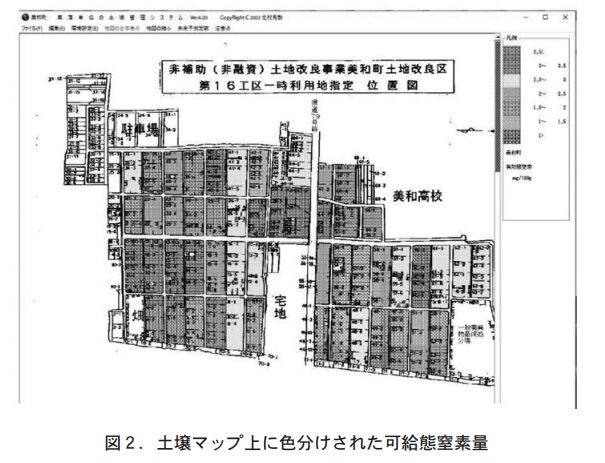
土壌調査から派生した成果として,1990年から土壌統ごとの窒素発現量の特性値を示した地力マップの作成を始めた。その後,県内の主な水田地帯で地力マップ作成のための調査を実施し,その結果を,地図として図示できるプログラムを開発,2002年にマニュアル 10)としてまとめた。それは,県内18地区を網羅しており,一筆ごとに色分けでき,将来予測もできるプログラムである(図2) 。各産地で,施肥対応の資料として活用されてきたが,現在は,そのプログラムの管理責任の問題から積極的に利用は進めていない。
(6) Designation of land enhancement areas
In this prefecture, land fertility enhancement areas have been designated in accordance with the Land fertility Enhancement Law. Needless to say, the back data for these areas is the survey data accumulated through the Soil Conservation Project. In the past, five areas were designated, and measures to improve the physical and chemical properties of the soil have been implemented with the cooperation of the local communities.
(7) Examples of research applications
定点調査で得られた各土壌統の面積と土壌炭素含量の結果から,県内から発生するメタン量を推定 11)した。県全域を網羅し,県全体の農耕地の実態を反映する統計データとするためには,土壌環境基礎調査時程度のデータ数が必要であると考える。
3. utilization of reference point surveys and other continuous use test data
(1) Utilization of data from the field (organic continuous use test)
試験場内の堆肥(牛ふん堆肥,豚ふん堆肥)連用試験の結果から,「家畜ふん堆肥連用ほ場ではリン酸肥料,カリ肥料の無施用栽培が可能である」を成果情報として発表した(瀧 12),2009) 。この他にも,リン酸肥料,カリ肥料の減肥に関する試験研究が行われ,これらの結果に基づいて,窒素成分に比べてリン酸,カリ成分が低いL型肥料が銘柄化され,現場で利用された。現在,県内で流通している系統肥料は,ほぼL型となっている。このことは,県内にBB肥料工場を抱えるJAあいち経済連と農業試験場が共同研究を進めることにより,産地の実態把握,減肥試験,現地実証,製品化,普及が円滑に行われてきたことによると考えられる。
(2) Data utilization in paddy fields (long-term continuous use paddy fields)
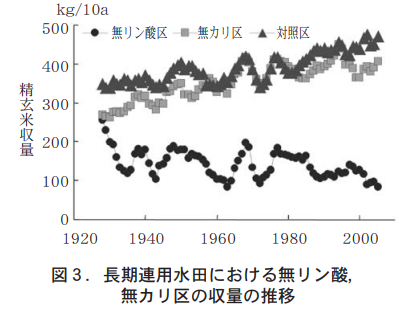
本県では,安城市(旧農事試験場内)の水田において1926年から四要素肥料試験と稲わら堆肥連用試験を実施している。この水田から得られた成果は多く,「収量は,無窒素,無リン酸区では収量の減少率が大きく,無石灰,無カリでは影響が小さかった(塩田ら13),1980)」 ,「堆肥区では,収量増加の効果が顕著である(塩田ら,1980)」 ,「堆肥225kg区における収穫時の由来別窒素は,肥料22%,堆肥13%,土壌65%である(塩田ら 14),1984)」 ,「堆肥施用により還元の進行程度が大きい(大橋ら 15),2015)」等が発表されている。
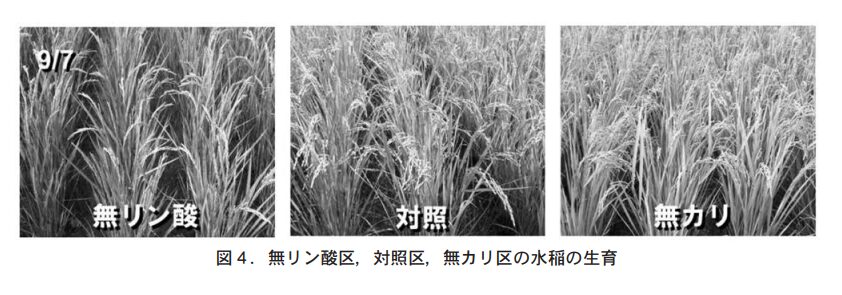
また,長期連用水田の無リン酸,無カリ栽培の試験結果(図3,4)の解析とそれを補う試験結果から,水田におけるリン酸及びカリの減肥が検討され,「持ち出し量分のリン酸,カリを補給していれば少なくともその時点の土壌状態は維持できる」と結論づけられている(池田 16),2007)
(3) Utilization for organic material application standards
The standards for the application of organic materials provide standards for the application of organic materials distributed in the prefecture, including livestock manure (Table 1).
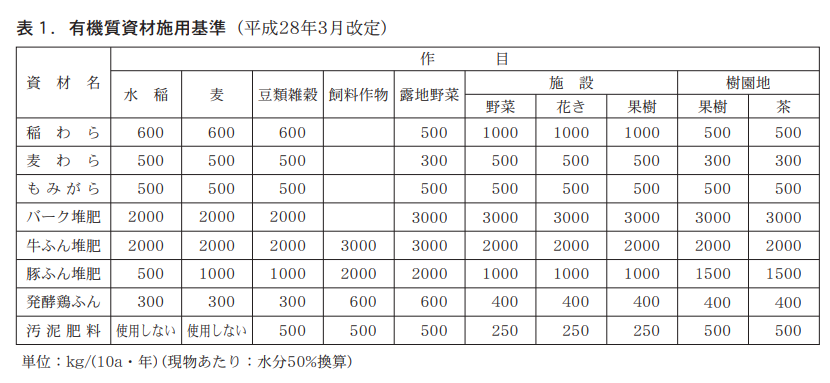
The application amounts and precautions for application reflect the results of the reference point survey and other continuous organic matter application tests. The following are shown as application effects and precautions.
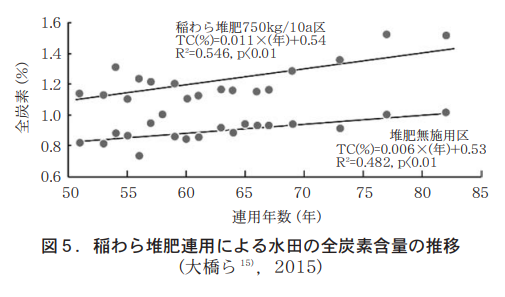
In (1) paddy field, organic matter in the soil does not decrease even if organic materials such as compost are not applied for more than 80 years, as shown in Figure 5. Furthermore, the application of compost makes the soil fertile with accumulated organic matter.
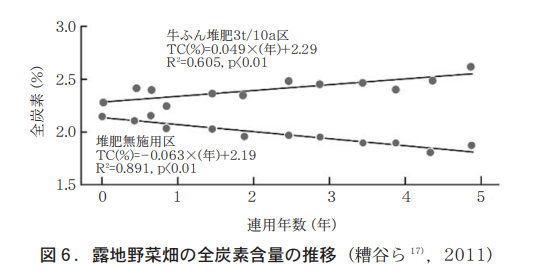
In the field, as shown in Figure 6, if organic materials are not applied, the organic matter in the soil decomposes and fertility declines. Therefore, the application of organic materials is an indispensable technology in the field.
When the free iron oxide content of the crop soil is less than 1.5% in a paddy monoculture, the maximum amount of bark compost and rice straw compost should be applied is 1000 kg/10a to prevent fallout. Especially in fields with low iron content, the application of large amounts of organic materials should be avoided.
④90年間の稲わら堆肥連用試験において,稲わら堆肥区で明確な鉄含量の減少が見られる。堆肥2000kg/10a程度の施用は,数十年,百年のスケールでみると,鉄欠乏による秋落ちを助長する可能性が高い。
The standard soil diagnostic value of humus in field soil is 3-5%. In the case of an open vegetable field on yellow soil, humus content reached 51 TP3T after 10 years of continuous use of 3000 kg/(10a/year) of cattle manure and 2000 kg/(10a/year) of pig manure.
Therefore, application of less than these standard amounts is sufficient to maintain soil fertility. If more than the standard amounts are applied, the discharge of nitrate nitrogen into groundwater and rivers will be extremely high, and the discharge of dinitrogen monoxide, which has a great impact on global warming, will increase, resulting in a great burden on the environment.
4. other soil data applications
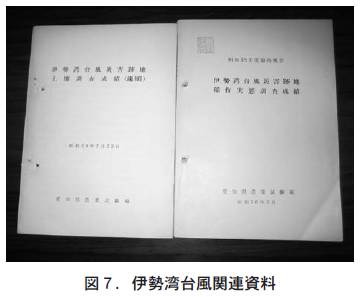
その他にも土壌調査データが活用された事例を紹介する。昭和34年9月に来襲した伊勢湾台風により海水が流入した地域の水稲生育状況及び土壌調査を行った成績書「伊勢湾台風災害跡地稲作実態調査成績 18)」 ,「伊勢湾台風災害跡地土壌調査成績 19)」に掲載されている塩害の実態及び除塩経過については,東日本大震災時に,現場復旧に向けた研究成果として情報提供した(図7) 。
5. suggestions for future directions (towards the way data is used as required in the field)
(1) Conduct soil surveys with a primary focus on crop productivity
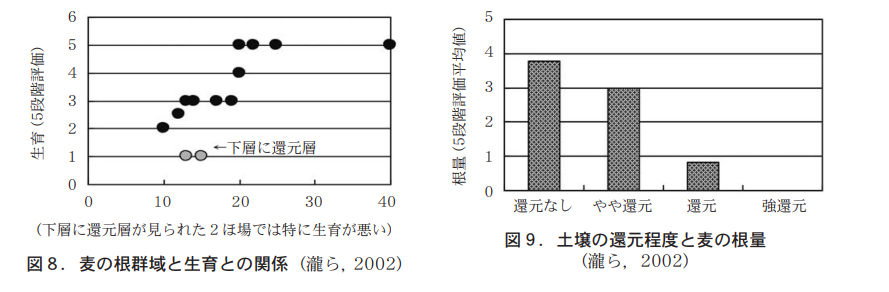
土壌断面調査については,土壌調査結果と作物の生産性とを関連付けてまとめることにより,生産現場に提供できる情報が格段に増えると考える。そのため,作物の根系と土壌調査結果の関連付けを行い,さらに地上部の生育,品質との関係性を考察することが重要であると考える。例えば,「麦の生育と主要根群域との関係 20) (図8)」 ,「麦の根量と土壌の還元程度との関係 20) (図9)」 ,「ハウスミカンの収量,品質と土壌診断基準 21) (図10)」などがあげられる。また,施設野菜について,根系と土壌調査結果を図示した資料を作成した(日置ら 22),2009) 。図11にその一例(ナスの根量)を示したが,資料には,メッシュごとの土壌調査・分析結果(pH,EC,硝酸イオン濃度,ち密度)も並記されている。それらは産地における土壌改良や施肥位置の決定に有益な情報となると考えられる。
(2) Conduct soil surveys targeting production areas
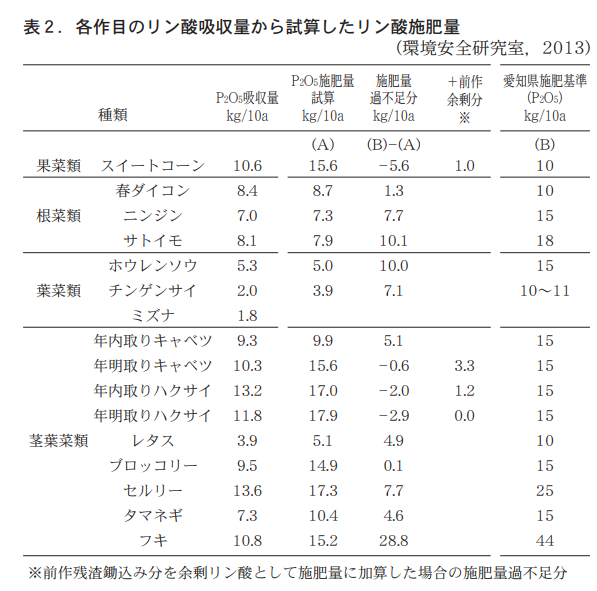
その他の調査事例として,2005〜2007年,畑作物17地域14品目について,栽培管理実態調査,土壌調査,作物収量・成分吸収量調査を実施した。その結果 23)から,作物ごとの施肥量と吸収量の関係や土壌中の養分の多少が明らかとなり,施肥指導に役立つ資料を作成した(表2) 。このように,同じ作物である程度まとまった点数を調査することで,現場の協力も得られやすく,解析もしやすい。また,調査を定期的に実施する際も土壌の変化を産地ごとにとらえることができ,施肥改善や土壌管理指導にも繋げられやすいと考える。
(3) Method of providing data
JA-Aichi Economic Federation is constructing a system to obtain and use various agricultural information from prefectural maps in a joint research project with the National Research Institute and Nagoya University.
In the near future, the information that can be provided will be enhanced by adding soil maps and soil data to it.
In the future, it is expected that digital information will be developed so that farm management will be possible on smartphones and tablets.
(4) Development of physicality diagnosis method
In order to provide detailed guidance for each field, it is important to diagnose the physical properties of the soil before diagnosing the soil chemistry. The first priority should be to determine whether or not conditions are in place for normal root growth, and if so, to improve these conditions. In the diagnosis of poor growth in the field, the cause is often the densification of the subsoil or poor drainage. For quality-oriented crops such as fruit trees and vegetables, it is important to fully understand the movement of moisture and water retention in the soil, but it seems that no such means have been established. Therefore, it is necessary to develop and disseminate a physical property diagnosis method that can be easily utilized in the field in the future.
6. at the end
In the agricultural field, there is a growing trend toward the development and diffusion of technologies that aim to make farming "easy" and "accessible to everyone" by making full use of ICT, AI, and other technologies. On the other hand, it is true that we can share the "joy of production" by walking through the field one by one, digging holes while listening to the voices and concerns of individual producers, checking soil hardness, drainage, and root distribution, and discussing the growth of crops. In the future, it would be desirable for all those involved in soil fertilization to review the assets of the soil fertilization field to date and discuss bringing them back to life.
References
(1) Comprehensive Report of the Basic Survey for Land Conservation. Aichi Prefecture. p.1-785 (1978)
2) Soil map of Aichi Prefecture. Aichi Prefectural Agricultural Experiment Station. p.1-33
3)土壌環境基礎調査(定点調査)成績書(尾張東部地域).p.1−149 (1979)
〜土壌環境基礎調査(定点調査)成績書Ⅳ(尾張西部地域).p.1−91(1997)
4)農作物の施肥基準.愛知県.p.1−281 (2016)
5)農作物の施肥基準.愛知県.p.22(2016)
愛知県の主要産地における野菜の養分吸収量と土壌実態.
愛知県.1−40(2013)農業の新技術No.73.p.1−91(2002)
6)農業の新技術.No.21.愛知県.p.1−54(1984)
7)農業の新技術.No.68.愛知県.p.1−54(1996)
8)長谷川徹ら.愛知県下の農耕地土壌の地力変化の実態.
愛知農総試研報A10.182−195(1978)
(9) Ikeda, A. et al. Actual condition of soil fertility of arable soils in Aichi Prefecture. Aichi Agricultural Experiment Station Research Report 20. 329-338 (1988)
10) New Technology in Agriculture "Soil Management System in Aichi Prefecture" .No.73, Aichi Prefecture. p.1-91 (2002)
11)瀧勝俊ら.愛知県下の水田土壌肥沃度の変遷にともなう,メタン,二酸化炭素生成量の変動推定:土壌環境基礎調査の結果に基づいて.
日本土壌肥料学会講演要旨集39(1993)
12)瀧勝俊ら.家畜ふん堆肥連用ほ場におけるリン酸肥料,カリ肥料無施肥栽培.
平成21年度「関東東海北陸農業」研究成果情報(2009) .
http://www.naro.affrc.go.jp/org/narc/seika/kanto21/#10
13)塩田悠賀里ら.四要素及び堆肥の長期施用による水田土壌の理化学性の変化と水稲の生育について.
愛知農総試研報12.52−60(1980)
14)塩田悠賀里ら.水稲の窒素吸収からみた堆肥連用の短期及び長期的評価.
愛知農総試研報16.43−51(1984)
New Technology of Agriculture, No.68, Aichi, Japan. p.1-54 (1996)
15)大橋祥範ら.稲わら堆肥89年間の連用がイネの収量.リン収支に及ぼす影響.
愛知農総試研報47.23−30(2015)
16)平成22年度関東東海北陸・土壌肥料部会秋季研究会.
土壌診断に基づく施肥節減実践の課題と展望(2010)
17)糟谷真宏ら.牛ふん堆肥または豚ぷん堆肥を連用する黄色土野菜畑における5年間の養分動態.
愛知農総試研報43.137−149(2011)
18)昭和35年臨時報告 伊勢湾台風災害跡地稲作実態調査成績.
愛知県農業試験場.p.1−132(1961)
19) Results of Soil Survey at the Site of Typhoon Ise Bay Disaster. Aichi Prefectural Agricultural Experiment Station. p.1-31 (2010)
(20) Soil and soil development in Aichi. Aichi. p.45-46(2005)
21)瀧勝俊ら.ハウスミカン園の土壌特性と改良目標の一試案.
愛知農総試研報37.117−125(2005)
(22) Hioki, M. et al. Root system structure of institutional vegetables. Aichi Prefectural Agricultural Experiment Station. p.1-117 (2009)
23)環境安全研究室.愛知県の主要産地における野菜の養分吸収量と土壌実態.
愛知県農業総合試験場.p.1−40(2013)